This matters because it tells us something essential about the Czech lands: beer was not perceived only as a festive or refined product, but as part of ordinary food and social life. The word itself still carries that plain familiarity. Pivo is, in a way, the drink. When someone in a hospoda asks for jedno pivo, "one beer", they are not entering an elite tasting culture; they are asking for something normal, shared and immediately understood.
This helps explain why Czech beer is different from many beers built mainly as image products. Its prestige comes first from habit, expected quality and a simple ritual: sitting down, ordering, drinking and talking. It does not need to be turned into a myth, because it already belongs to the social landscape. [1]
From urban and monastic roots to the Plzeň breakthrough
The history of beer in the Czech lands runs through monasteries, towns, brewing rights, technical innovation and local rivalries. For centuries, production was tied both to domestic life and to towns with brewing privileges. The most famous turning point came in Plzeň in 1842. According to the official history of Plzeňský Prazdroj, the quality of local beer had become uneven, and citizens with brewing rights decided to establish a new brewery; on 5 October 1842, brewer Josef Groll brewed the first batch of the new pilsner beer.
From that moment, a huge shift began: a pale, golden, clear, bottom-fermented beer with clean bitterness and great drinkability became an international model. Pilsner Urquell still presents itself as the original golden pilsner brewed in Plzeň. But reducing Czech beer to pilsner alone would be misleading. Plzeň matters because it gave its name to a style copied across the world, yet Bohemia and Moravia also have dark beers, amber beers, town beers, monastic traditions, industrial breweries and, more recently, craft breweries.
České Budějovice is important too: Budějovický Budvar notes that the modern brewery was founded in 1895 in a city whose brewing tradition was already much older. Czech beer, then, is not just a successful drink. It is an urban, economic and technical history. [2][3][4]
Water, malt, hops and technique: why Czech flavour is recognizable
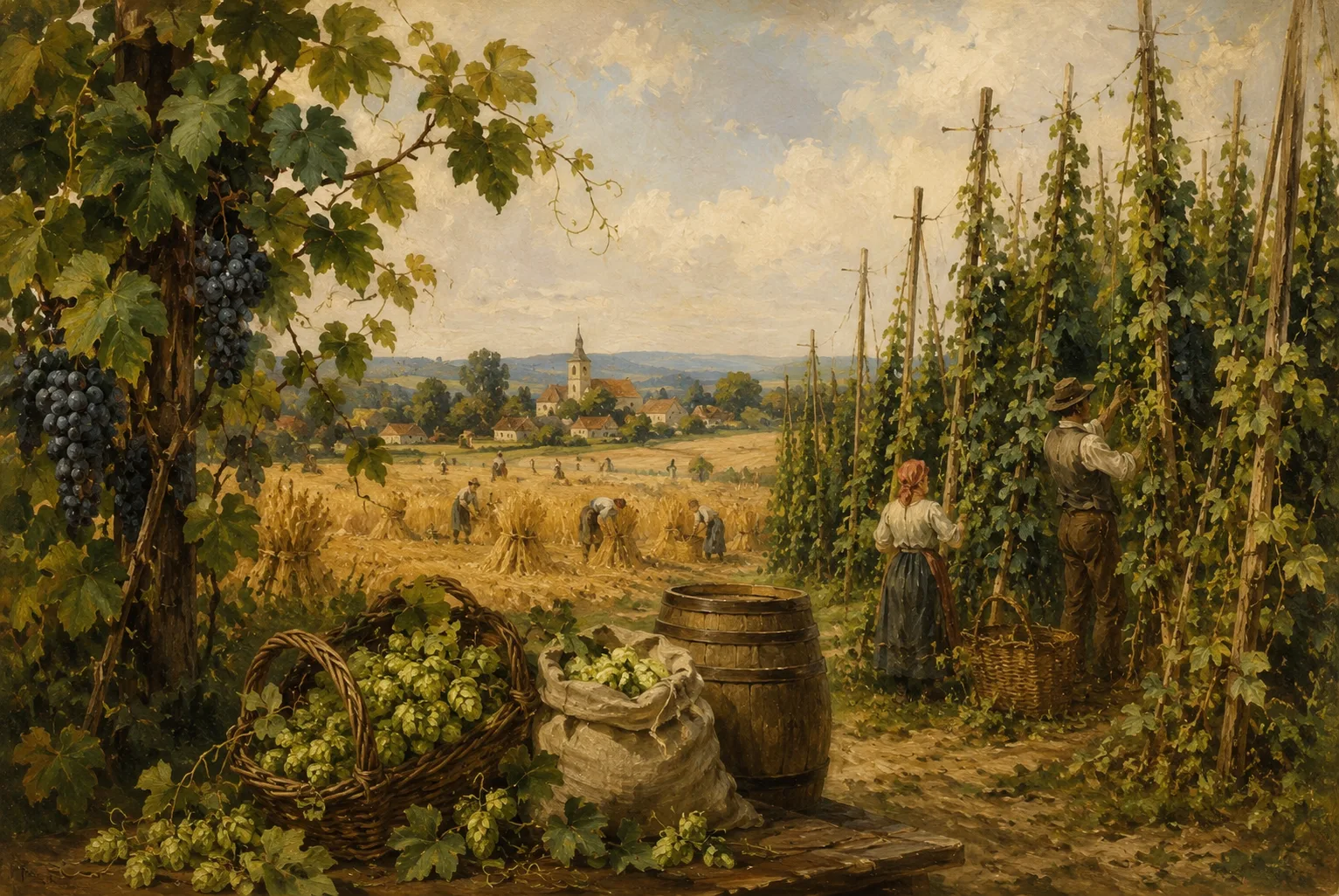
People often describe Czech beer with vague but understandable words: good, drinkable, bitter, traditional. They are not wrong, but they do not go far enough. Its specific character comes from a combination of ingredients, technique and consumer expectations. Žatec hops, also known as Saaz, are one of the strongest symbols. UNESCO describes Žatec and the Landscape of Saaz Hops as exceptional evidence of a long tradition of hop growing, processing and trade.
But hops alone do not explain everything. The protected geographical indication České pivo is not simply a label for beer made in Czechia: according to the Research Institute of Brewing and Malting, its character also depends on production methods such as decoction, wort boiling and two-stage fermentation. The Czech food inspection authority also explains that the PGI Czech Beer requires rules on ingredients, production method, documentation and control.
Put simply, Czech character is not just a flag on the label. It is a production structure. A classic Czech lager tends to show more malt presence, a firm but not aggressive bitterness, generous foam, a certain residual fullness and high drinkability. It is not an extreme beer. It is a beer of balance, and balance is hard to imitate well. [5][6][7]
Czech styles: výčepní, ležák, dark, special and alcohol-free
To understand beer in Czechia, it helps to know the local classification. Czech law distinguishes several categories, including stolní, výčepní, ležák, plné, silné, nízkoalkoholické and nealkoholické. The most familiar category for many drinkers is probably výčepní pivo, often associated with 10° beers, lighter and suited to everyday drinking. Then comes ležák, the lager proper, usually linked with 11° and 12° beers. The word ležák evokes resting and maturation, not just colour or alcohol.
There are also fuller beers, strong beers, dark beers (tmavé), semi-dark or amber beers (polotmavé), wheat beers (pšeničné) and, in recent years, a lively craft scene: IPA, APA, stout, sour, seasonal beers and barrel-aged beers. Still, the heart of the market remains bottom-fermented lager.
According to the Czech Beer and Malt Association, Czech drinkers in recent years have preferred especially 11°–12° ležák, while 7°–10° výčepní beers have lost ground. Alcohol-free beer is also important: in 2025 it exceeded 11% of total domestic consumption. Czech beer remains traditional, but it is not frozen in time. [8][10]
Degrees and alcohol: the great misunderstanding of "twelve-degree" beer
One of the most common mistakes among visitors to Czechia is to think that a 12° beer contains 12% alcohol. It does not. The numbers 10°, 11° and 12° refer to the concentration of the original wort, the extract before fermentation, not directly to final alcohol by volume. Czech legislation uses the term extrakt původní mladiny, "original wort extract", and classifies, for instance, výčepní in the 7–10 range and ležák in the 11–12 range.
Actual alcohol then depends on how much of that extract is fermented, on the yeast, the recipe and the degree of attenuation. In practice, a 10° beer is often around 4% alcohol, while a 12° beer is often around 5%, but this should not be treated as a fixed formula. Staropramen also notes that 10°P, 11°P and 12°P do not directly indicate alcohol, but the beer's gravity.
The distinction matters because it explains Czech drinking habits. A 10° desítka is lighter; a 12° dvanáctka has more body, malt and structure. The difference is not only alcoholic, but sensory. Behind those simple numbers lies a whole way of classifying and perceiving beer. [8][9]
Plzeň, České Budějovice, Žatec: a geography of taste
Czech beer has a very readable geography. Plzeň is the city of pilsner, and its name has become international. České Budějovice is tied to the Budweiser/Budvar world and a long urban brewing tradition. Žatec stands for hops, one of the most delicate and recognizable aromatic components. Alongside these famous names there is a wider network: Velké Popovice, Nošovice, Třeboň, Humpolec, Svijany, Černá Hora, Litovel, Bernard, Primátor, Krušovice, Staropramen in Prague and many others.
In Czechia, these are not just brands. They often carry regional loyalties, family habits, local preferences and small forms of belonging. Some drinkers choose a brand by tradition, others judge the pub by the quality of its draught beer, and others follow microbreweries and specials. Žatec is especially revealing because it links agriculture and industrial culture: UNESCO did not recognize a simple hop field, but a historical landscape of fields, villages, drying houses, warehouses and know-how.
Saaz hops are famous for their fine, aromatic profile, less aggressive than many modern IPA varieties. Plzeň represents nineteenth-century innovation; České Budějovice shows the relationship between beer, city and local identity. Seen this way, Czech beer is not one style. It is a map. [3][4][5]
How much Czechs drink: a world record, but declining consumption
Czechia remains one of the world symbols of beer consumption, but recent data show a transformation. According to the Czech Beer and Malt Association, average consumption in 2025 fell to 121 litres per person, described as a historical low; total production reached 19.96 million hectolitres, down 4.3% compared with 2024, while domestic consumption fell to 14.86 million hectolitres. In 2024 the same source reported 126 litres per person.
Yet the most interesting question is not only how much is drunk, but where it is drunk: in 2025 only 28% of beer was consumed in restaurants and pubs, while 72% went through retail. This points to a cultural shift: less draught beer in the hospoda, more bottles and cans at home. The Brewers of Europe had already shown for 2022 that retail consumption outweighed hospitality.
Internationally, Kirin reported Czech per-capita consumption of 152.1 litres in 2023, keeping Czechia in first place worldwide, but with an important methodological note: figures can vary depending on the statistical source. The trend is clear enough. Czechs still drink a great deal of beer compared with the rest of the world, but less than before; they go to pubs less often and choose alcohol-free or retail-bought products more frequently. [10][11][12]
Hospoda, foam and everyday life: beer as a social fact
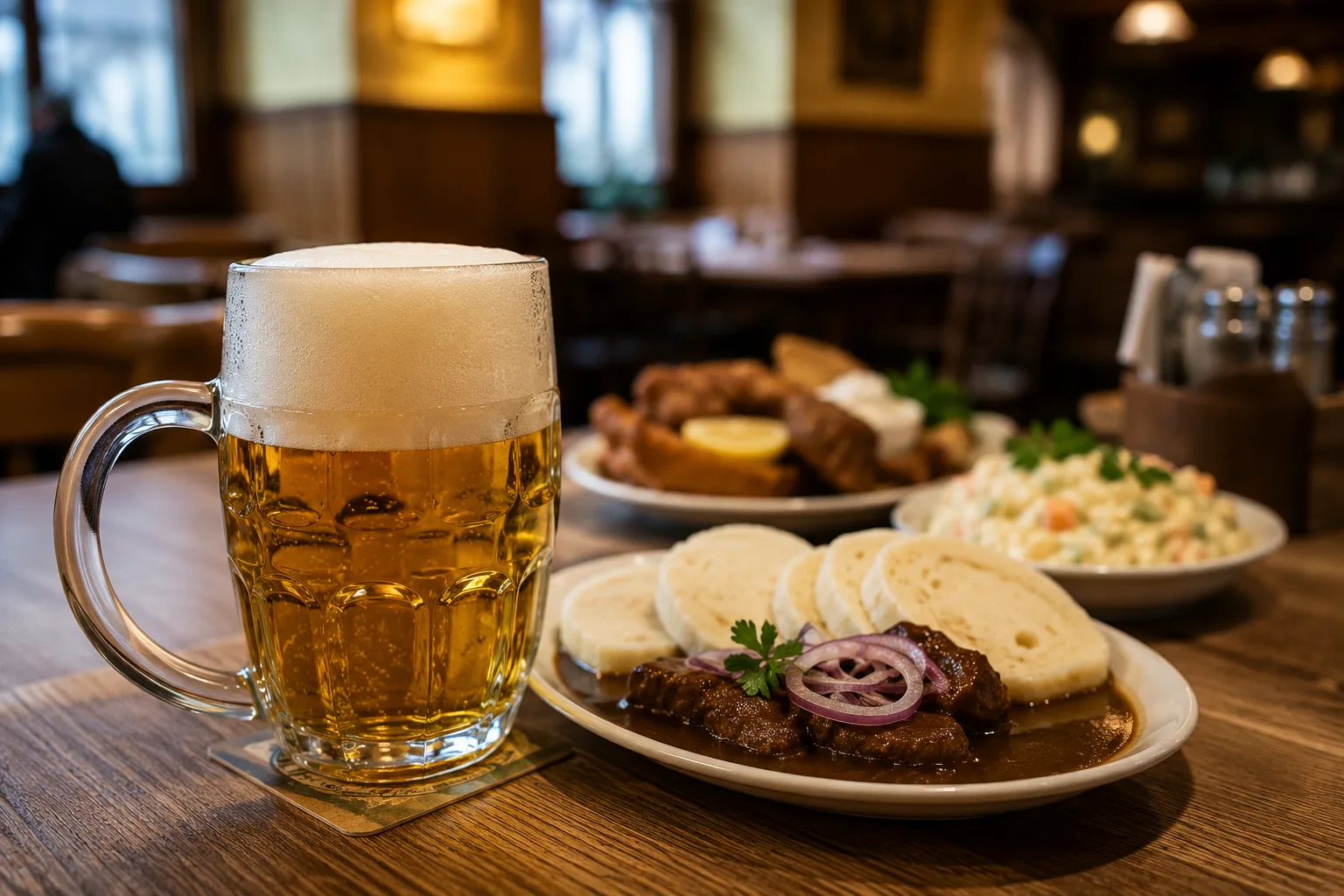
Czech beer cannot be understood only through labels or production data. One must also look at the hospoda, the popular pub: a place of meeting, pause, conversation and habit. For decades, draught beer was an accessible form of social life. You did not need to be an expert, spend much money or dress in any particular way. You sat down and ordered.
Service has its own language too. In many Czech pubs, foam is not seen as a flaw or as a trick to serve less beer. It is part of the experience: it protects aroma, adds creaminess and defines proper pouring. Today people often speak of different serving styles such as hladinka, šnyt and mlíko, although their spread depends on the pub. Staropramen notes that in Czechia one can order a large or small beer, that if nothing else is specified one often receives a classic ležák, and that foam is an important part of service.
Yet this culture is now changing. The decline of pub and restaurant consumption shows that part of the older beer sociability has weakened. It is not disappearing; it is changing shape. [9][10]
A strong tradition precisely because it is not static
Czech beer works because it combines things that rarely coexist so well: popular simplicity and technical precision, everyday habit and international reputation, industrial production and local memory. The name pivo speaks of a drink that entered the language as something basic, almost obvious. Plzeň tells the story of the 1842 innovation that changed world taste. Žatec tells of the link between agricultural territory and aromatic quality.
The classification into výčepní, ležák, plné and silné shows that behind the apparent simplicity of the glass there is a precise legal and production structure. Recent data, meanwhile, show a less folkloric reality than people often imagine: Czechs still drink a lot of beer, but less than in the past; consumption is moving from pubs to homes; alcohol-free beer is growing; preferences are shifting.
That may be the most interesting point: Czech beer is not a liquid museum. It is a living tradition, and therefore also a contradictory one. Its strength does not lie only in being "one of the best beers in the world", a nice but rather thin formula. It lies in the fact that for many Czechs beer remains a measure of normality: people judge a pub by how it serves beer, recognize a town by its breweries and immediately notice when a beer is tired, warm or badly poured. [1][2][5][8][10]







Discussion
Join discussion!
There are already 0 comments on this article in the forum.