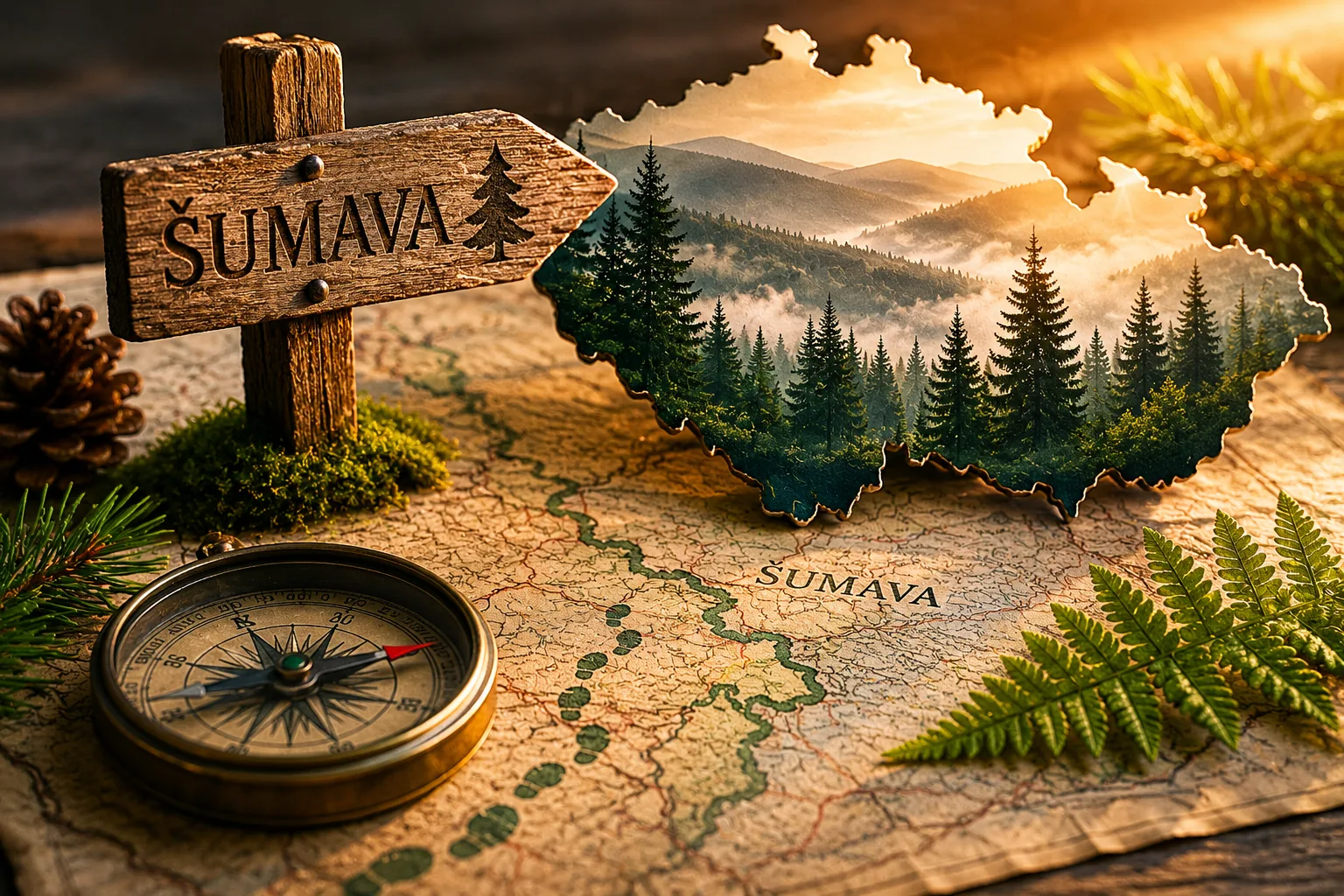
Its profile is not that of high, dramatic mountains. Šumava exerts a quieter charm: vast forests, rolling uplands, soft valleys, cold waters, deep silences and broad horizons. It is a mountain landscape to cross rather than to conquer, a place that invites walking, watching, stopping and letting oneself fall into the natural rhythm of the area. [2] [4]
Šumava’s strength lies precisely in this continuity. Forests, glacial lakes, peat bogs, mountain meadows and streams form a broad and highly recognizable natural mosaic. Šumava National Park and the surrounding protected landscape preserve some of the most valuable environments of the Czech mountain landscape, making the region one of the major green spaces of Central Europe. [2] [5]
A history of borders, forests and passages
The history of Šumava is closely tied to its geography. For centuries, the region functioned as a border area, but also as a zone of contact. Its forests, ridges and passes did not only separate territories: they also enabled exchanges, crafts, trade routes and forms of mountain life adapted to local conditions. [1] [3]
Over time, Šumava was home to villages, forestry, craft production, glassmaking, pastures and waterways used for floating timber. Nature was not a backdrop detached from everyday life: it was the basis of the local economy, of work and of settlement patterns. [8] [9]
A major turning point in the region’s modern history was the formal recognition of its environmental value. The Šumava Protected Landscape Area was established in 1963, while Šumava National Park was created in 1991. UNESCO had already included the region in its network of Biosphere Reserves in 1990, confirming its international importance. [3] [5]
This process of protection turned Šumava into a major accessible natural heritage area. The region keeps the charm of an inhabited mountain landscape while protecting delicate ecosystems and landscapes of great value. Its recent history shows how a borderland can also become a place of conservation, knowledge and respectful tourism. [3] [5]
Forests, lakes and peat bogs: a landscape far more varied than it first appears
The first image usually associated with Šumava is the forest. And understandably so: woodlands are the defining feature of the region, the great green body of the land.
But Šumava is not simply “one big forest”. Its beauty lies in the variety of its environments, which change gradually along paths, elevations and valleys. [2] [4]
Šumava’s forests are accompanied by glacial lakes, peat bogs, mountain meadows and streams. Together, they make the landscape rich and never monotonous. A walk may begin in dense woodland, reach a dark sheet of water, cross a wetland on wooden boardwalks and then open onto a high meadow where the sky feels wider and the wind more present. [2] [6]
The glacial lakes are among the most evocative features. Černé jezero, Čertovo jezero and Plešné jezero are names closely tied to the image of Šumava. While not vast, these lakes possess a striking presence: cold water, wooded slopes, filtered light and a deep sense of quiet. [2] [4]
The peat bogs add an almost northern character. They are wet, slow, delicate environments where water remains in the landscape and creates a very specific ecosystem. Beyond their visual appeal, they play an important role in water retention and in the region’s natural balance, helping the land hold moisture and water. [6]
The source of the Vltava and the symbolic value of water
One of Šumava’s most evocative places is the source of the Vltava, the river that crosses Bohemia and Prague before joining the Elbe. The source lies near Kvilda, on the slope of Černá hora, at about 1172 metres above sea level. It is an accessible destination, popular with hikers and cyclists because it combines a simple route with powerful symbolism. [7]
The Vltava is not only an important river in geographical terms. In Czech culture it is a marker of identity, music, history and landscape. Knowing that its course begins in Šumava helps explain how deeply this region is linked to the country’s imagination. [7]
Water is present everywhere in Šumava: in torrents, wetlands, glacial lakes, peat bogs and the small streams that run through the forest. The information centre in Kašperské Hory gives special attention to the role of water in the landscape, explaining how it contributes to natural life and the stability of local ecosystems. [6]
This constant presence of water makes Šumava a particularly harmonious territory. Water shapes the paths, feeds the valleys, accompanies the meadows and gives depth to the forests. Even without scientific knowledge, walkers can easily sense that water is not a detail: it is one of the main threads holding the whole landscape together. [6] [7]
Villages and mountain culture
Šumava is not made only of protected nature. It is also a region of villages, small towns, museums and local traditions. Places such as Sušice, Kašperské Hory, Vimperk, Volary, Kvilda, Modrava and Železná Ruda serve as gateways to the landscape, but also as places where a concrete memory of mountain life is preserved. [4] [8]
Local culture is tied to crafts, materials and the resources of the land. Wood, water, glass, pastures and transit routes shaped everyday life for generations. The Museum of the Šumava, with collections devoted to local history, historic furniture, glass and material culture, shows this relationship between environment and human labour very clearly. [8]
Glassmaking is one of the region’s most interesting traditions. The forests supplied wood, the mountain environment offered suitable conditions, and over time settlements and workshops linked to this production developed.
Šumava therefore preserves a cultural dimension that completes its natural one. The floating of timber along waterways also belongs to this history. Timber rafting, recognized by UNESCO as intangible cultural heritage within a wider international context, allows rivers and streams to be read not only as natural elements, but also as routes of work, technique and memory. [9]
An ideal landscape for slow tourism
Šumava is an ideal destination for slow, accessible and positive tourism. It does not require extreme undertakings or alpine skills. Its beauty is discovered by walking, cycling, watching the forest, following a stream or reaching a glacial lake without haste. [4] [7]
In summer, the region offers trails, cycle routes, meadows, shaded forests and paths toward springs and viewpoints. In autumn, it becomes a landscape of deep colours, golden woods and quieter days. In winter, it is appreciated for cross-country skiing, snowy walks and the intimate atmosphere of mountain villages. [4]
One of its strengths is its ability to speak to different kinds of visitors. A family can find easy routes and educational places; a hiker can plan longer itineraries; a photographer can look for mist, lakes and soft light; anyone seeking rest can simply walk and breathe in a peaceful environment. [4] [6]
Šumava’s tourist value does not lie in instant spectacle, but in the quality of the experience. It is not a region that can be consumed in a quick visit. The more time one gives it, the more details emerge: the sound of water, the shape of the meadows, the smell of the forest, the villages, the paths and the shifting light. [2] [4]
A region of European value
Šumava has a value that goes beyond the borders of the Czech Republic. Its position along the border with Germany and Austria links it to a wider natural system that also includes the Bayerischer Wald and the broader Bohemian Forest. [1] [3]
UNESCO describes the Šumava Biosphere Reserve as part of a mountain region that crosses the border between the Czech Republic, Germany and Austria. This geographical continuity makes Šumava a clear example of a shared European landscape: forests, water, animals and climate do not follow the political lines drawn on maps. [3]
This cross-border dimension is one of the region’s most attractive aspects. Šumava shows how nature can create continuity between different territories. Where the border once carried great historical weight, the landscape now allows a broader reading made of ecological links, trails, cooperation and protection. [3] [5]
The European value of Šumava is not abstract. It can be seen in its vast forests, protected ecosystems, relationship with the Bayerischer Wald and the possibility of viewing the whole area as a common heritage of Central Europe. [3] [5]
Šumava as a landscape of memory
Šumava is also a landscape of memory. Not in a monumental sense, but in a more discreet way: through villages, paths, museums, old crafts, waterways, forests and places that preserve traces of everyday life over generations. [8] [9]
This memory does not weigh the landscape down. On the contrary, it makes it more interesting.
A walk through Šumava can be simply a natural experience, but it can also become a way of understanding how people lived in a mountain region. Wood, water, glass, pastures and border connections are not isolated details: they tell the story of the relationship between human communities and the land. [8] [9]
Šumava therefore has a rare quality: it joins natural beauty and cultural depth without needing grand scenery. Its strongest elements are often simple: a dark lake among the trees, a silent peat bog, a road toward a village, a spring, a local museum, a path that follows water. [2] [6] [8]
A positive geography to know
Šumava deserves to be known as one of the great natural regions of the Czech Republic. Its geographical importance is clear: it protects forests, water, peat bogs, glacial lakes and mountain landscapes of great value. But its deeper strength lies in its ability to bring all these elements together in a coherent and accessible experience. [2] [3] [5]
It is a positive region because it offers nature without excess, tourism without haste, culture without display and landscapes that remain in the memory. It does not rely on immediate grandeur, but on duration: the more one crosses it, the clearer its identity becomes. [2] [4]
Šumava also helps reveal a less urban and deeper side of the Czech Republic. Alongside historic cities, castles and cultural centres, there is a country of forests, rivers, soft mountains, villages and silences. Šumava is one of the fullest expressions of this green geography. [1] [3] [4]
Its appeal comes from balance: protected nature, local memory, accessible tourism and European value. It is a landscape that does not need to be forced in order to appear interesting. It is enough to follow its paths, listen to its water and watch how forests, lakes, villages and uplands together create one of the most evocative regions of Central Europe. [2] [3] [7]
Sources







Discussion
Join discussion!
There are already 0 comments on this article in the forum.