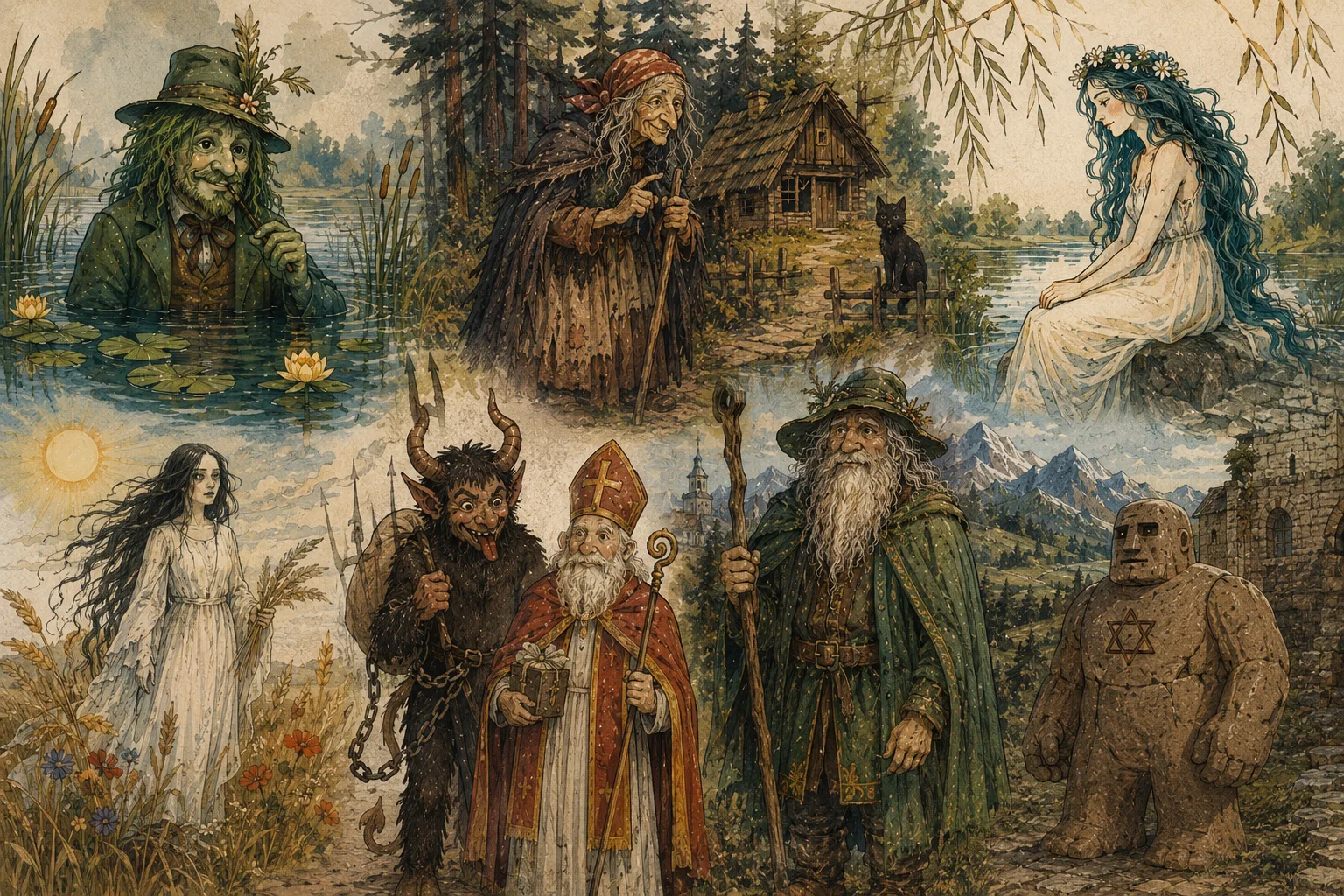
In Slavic mythology, the rusalka is often an ambiguous presence: beautiful, musical, close to nature, yet also connected with death and the idea of a broken life [5]. In the Czech lands she became especially famous through Antonín Dvořák’s opera Rusalka, with a libretto by Jaroslav Kvapil, where the water nymph longs to enter the human world and pays a terrible price for crossing that boundary [6]. Vodník and Rusalka work well together because they reveal two sides of the same symbol: water as attraction and danger, as a threshold between home and the unknown, everyday life and magic. They are not “monsters” in the modern sense. They are figures that suggest, without preaching, that what draws us in can also keep us captive.
Forests, stoves, and lonely cottages: Ježibaba
Ježibaba is the witch of Czech and Slavic fairy tales: old, powerful, often unpleasant, tied to the forest and to places where the human world loses its sense of safety. Sometimes she is openly evil; at other times she is more ambiguous. She may hinder the hero, eat children, guard a secret, or test anyone who enters her territory. In that sense she is close to the Baba Yaga of the East Slavic world, although the traditions should not be automatically merged: Ježibaba is identified as a Czech and Slovak form connected with this broader family of witch-like figures [8].
In Czech, the word čarodějnice more generally means a female figure with magical powers; Czech sources connect her both with classic fairy tales and with demonological beliefs, where she can harm people, transform herself, or act through dark forces [7]. Her natural space is the edge: the edge of the village, the edge of the forest, the edge of ordinary morality. That is why Ježibaba is so effective in magical and woodland tales. She is not simply “the wicked old woman”: she embodies the fear of getting lost, of entering a house where normal rules no longer apply, of meeting someone who knows things other people do not. As a narrative figure she is remarkably strong because she needs very little scenery: a hut, a wrong path, a door opening in the woods.
Čert: the folk devil who enters the home
Čert is the devil of Czech tradition, but he does not always coincide with the solemn theological Satan of Christian imagination. In Czech fairy tales he can be clumsy, gullible, noisy, and sometimes almost comic; still, he remains a figure associated with punishment, fear, and hell. His liveliest presence in everyday culture is linked to the tradition of Mikuláš, on the evening of 5 December, when Saint Nicholas appears with an angel and a devil. According to tradition, good children receive sweets, while naughty ones are frightened by the čert, who in some versions threatens to carry them away in his sack [3] [4].
This scene says a great deal about Czech folklore: the supernatural does not live only in forests or castles, but can step into the street, the market, the home, and children’s lives. Čert matters because he makes an old form of popular teaching visible: good and evil are not explained through a treatise, but staged through three instantly recognizable characters — the saint, the angel, and the devil. Today, of course, many people experience the tradition in a more playful way, but its symbolic force remains. Čert works because he is threatening and theatrical at once: he frightens, but with a controlled, ritual, almost domestic fear. That is probably why he remains one of the most familiar figures in Czech culture.
Polednice: fear at the most ordinary hour of the day
Polednice, the “noon woman,” is one of the most unsettling figures in Czech folklore because she does not come at night, but in full daylight. That sets her apart from many European spirits and monsters, which belong to darkness. Her modern fame is tied above all to Karel Jaromír Erben’s ballad Polednice, included in Kytice: an exhausted mother threatens her child by calling Polednice, and the figure she invokes seems truly to enter the room [1]. The story is short, but powerful, because it turns an everyday scene — a tired mother, a crying child, lunch to prepare, the father returning from work — into a nightmare.
Polednice is not just “a monster for children”: she is the personification of domestic pressure, of a word spoken in anger, of fear taking shape. As a narrative figure, she is perfect for darker content because she needs no castles, graves, or storms. Noon is enough: the hour most exposed to light and apparently safe. That is where her modern force lies. Fear does not come from outside; it grows inside an ordinary home. By collecting and reworking folk material, Erben gave this figure such a strong literary form that Polednice remains one of the harshest and most memorable images in the Czech imagination [1] [2].
Mountains and cities: Krakonoš and the Golem
With Krakonoš, we move to the Krkonoše, where legend becomes local identity. Krakonoš is regarded as the lord, protector, or mythical spirit of the Giant Mountains: he defends the region from poachers, treasure hunters, and people driven by bad intentions [9]. His figure has not always been purely benevolent: local sources recall that in the past he could be whimsical, mischievous, or even dangerous, while today he is often portrayed as a just ruler of the mountains [9]. He is ideal for explaining the relationship between landscape and legend: he is not born from a city, but from a vertical, cold, demanding territory where the weather and the mountains seem to have a personality of their own.
The Golem, by contrast, belongs to another world: Prague, the Jewish Quarter, the memory of Rabbi Judah Loew ben Bezalel, and the legend of a clay creature created to protect the community [10] [11]. It should be treated carefully: it is extremely powerful for Prague, but it belongs above all to Prague Jewish tradition, not to Czech “peasant” folklore in the narrow sense. That difference is exactly what makes it valuable. Alongside Vodník, Čert, or Polednice, the Golem shows that the Czech imagination is not uniform: it is made of layers, languages, religions, and different memories. Krakonoš rules the mountains; the Golem inhabits the city and its history.
Why these figures still work
These seven figures endure because they are easy to remember, but they are not simplistic. Vodník gives a face to dangerous water; Rusalka turns desire into tragedy; Ježibaba gathers together the fear of the forest and of magic; Čert brings punishment into a popular feast; Polednice makes noon disturbing; Krakonoš binds a region to its mountain spirit; the Golem turns Prague into a place where legend, protection, and Jewish memory meet [1] [5] [9] [11].
Their strength lies exactly here: they should not be presented as isolated folkloric curiosities, but as characters that explain a concrete relationship with the world. Water, home, forest, mountain, city, family, fear, guilt, desire: everything passes through simple images. And when a folk figure survives in books, opera, festivals, tourism, and children’s stories, it means it no longer belongs only to the past. It continues to work because it still offers an immediate language for things that change very little: danger, mystery, protection, temptation, and the need to give shape to the invisible.
Bibliography






Discussion
Join discussion!
There are already 0 comments on this article in the forum.