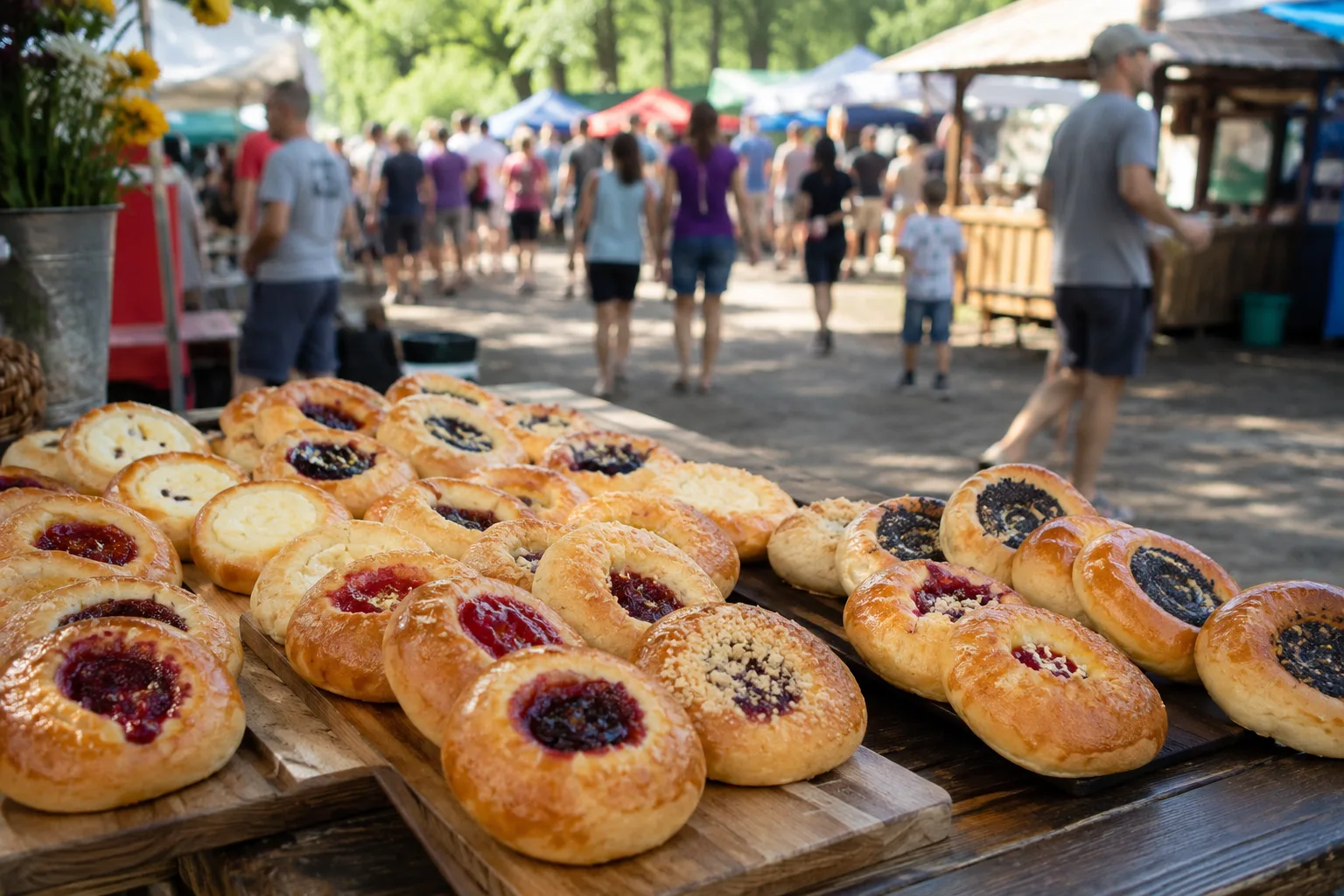
The point, however, is not only culinary. In the areas where Czech and Moravian immigrants settled between the nineteenth and early twentieth centuries, the kolache long remained a food of the home, the church, weddings, fundraisers and local gatherings. Over the generations it moved out of the family kitchen and into public space: something to sell, display, judge in competitions, eat in the town square and use as a symbol of belonging.
That is where the "kolache festival", as we understand it today, takes shape: not just a pastry fair, but a light, popular form of ethnic memory. Not everyone who attends has Czech roots; many come for curiosity, music, food and atmosphere. Still, the structure of the celebration — polka, traditional dress, dances, baking contests, festival royalty and parades — continues to point to a recognisable Czech-American genealogy. [1] [2]
Montgomery and Prague: the older roots
One of the oldest examples is Montgomery, Minnesota, with its Kolacky Days. The festival dates back to 1929: according to the official history of the event, about 6,000 people visited Montgomery for the first Kolacky Day, held on 1 October of that year. Even then, the pastry stood at the symbolic centre of the day: a report in the Montgomery Messenger noted that more than 1,600 kolacky had been eaten. The celebration later went through interruptions and changes: after Pearl Harbor it faded into the background, returned in 1948, became a summer festival in 1966, and in 1975 adopted the plural name Kolacky Days, moving to late July. Participation here is not just a matter of visitors: there are candidates for local royalty, volunteers, musicians, athletes, families, associations and town businesses. The official royalty page recalls that the contest began in 1931 with a very community-minded system: residents voted by donating one cent for their preferred candidate.
Another important centre is Prague, Oklahoma. Its Kolache Festival began in 1951 as a "dress rehearsal" for the city's fiftieth anniversary, in a town founded by Czechoslovak pioneers after the Oklahoma Land Run. After a pause, the celebration returned in 1965 and continues today. The festival's official source reports around 25,000–30,000 visitors in a town of roughly 2,300 people, with an estimated 50,000 kolaches consumed during the festivities. Here the celebration is more explicitly about identity: a parade, Czech costumes, entertainment, kolache contests, bread and wine. [3] [4] [5]
Texas: West, Caldwell and the kolache as regional identity
Texas has turned the kolache into something almost mythical. Not because it is "more authentic" than the original Czech tradition — in fact, it is often more hybrid — but because the pastry has become part of a highly visible regional culture. West, Caldwell, Ennis, La Grange, Schulenburg and other centres of Tex-Czech life have built, over time, a landscape of bakeries, polka, churches, associations and festivals.
Westfest, in West, is not technically only a "kolache festival", but it is one of the most important events linked to Czech heritage in Texas. It began in 1976 as a fundraiser for community projects — sports facilities, programmes for seniors, a community centre, the library and civic and cultural initiatives — and has raised more than one million dollars for the local community over the years. The town of West is also known as a stop for travellers on Interstate 35 who pull off the road to buy kolaches in local bakeries. In 2025, according to a local news outlet, Westfest drew about 20,000 people over a weekend in a town of around 2,500 residents.
Caldwell, by contrast, has a festival more directly centred on the kolache: it is held downtown every second Saturday in September, with free admission, an opening ceremony under the polka pavilion, the crowning of Miss Kolache Festival, SPJST Beseda youth dances, a kolache-eating contest, a baking championship, the Kolache Krunch 5K, polka music, a quilt show, museums, antique tractors, street rods, a classic car show and activities for children. In 2025 Caldwell celebrated its 40th edition: a sign that the festival is now a stable tradition, not just a tourist event. [6] [7] [8] [9]
Who really takes part: descendants, the curious, volunteers and local communities
The audience at kolache festivals is more varied than one might expect. There are, of course, descendants of Czech families: people who may no longer speak Czech, but who recognise in the pastry, the polka, the kroj and local surnames a piece of their family history. Then there are local residents with no Czech roots, because these festivals have often become civic events: opportunities to fund projects, promote the town centre, support associations, schools, museums and local groups. A third group consists of outside visitors: food tourists, families, music lovers and curious travellers who come because the festival is well known in the region.
In Prague, Oklahoma, the scale is striking: tens of thousands of visitors for a very small town. In West, Texas, the relationship between the local population and weekend attendance shows how much these events also function as "homecomings": former residents, relatives, extended communities and people who treat the festival as an annual reunion. Yet the participants are not only those who buy and eat kolaches. They are also the volunteers who set up the stands, the families who bake, the musical groups, the Beseda dancers, the royalty candidates, the contest judges, the craftspeople, the vendors, the local museums, radio stations and chambers of commerce.
In other words, the kolache is the symbol; the real substance of the festival is cooperation. That helps explain why some festivals have lasted for decades: they live not only on nostalgia, but on practical organisation, generational renewal and usefulness to the town. [4] [5] [7] [8] [10]
A small pastry, a long memory
Seen from a distance, kolache festivals might look like minor local events: pastries, stalls, music, contests, costumes. Seen more closely, they reveal an interesting historical mechanism: a migrant community carries a recipe with it; the recipe survives within families; it then becomes a public emblem; finally, it is adopted even by people who no longer belong directly to the original community. That is how a tradition stops being only "ethnic" and becomes local.
Montgomery shows longevity, with roots in 1929; Prague shows numerical strength, with a declared attendance of 25,000–30,000 visitors; West shows the link between Czech culture, fundraising and regional tourism; Caldwell shows the more contemporary urban-festival format, with contests, a 5K, vendors, museums, music and family activities. There is, of course, a risk that everything becomes decorative folklore: a costume, a Czech word, a pastry sold in large quantities.
But there is no need to push the criticism too far. These festivals work precisely because they are simple, accessible and repeatable. They do not pretend to be seminars on Czech history; they allow many people to encounter a piece of that history without embarrassment or distance, while walking between a parade, a bakery, a polka band and a kolache contest. Perhaps that is their real strength: they turn memory into something people can eat, hear and share. [1] [2] [6] [9]






Discussion
Join discussion!
There are already 0 comments on this article in the forum.